
Make Your Living Trust
Nolo
ISBN: 978-1413332827
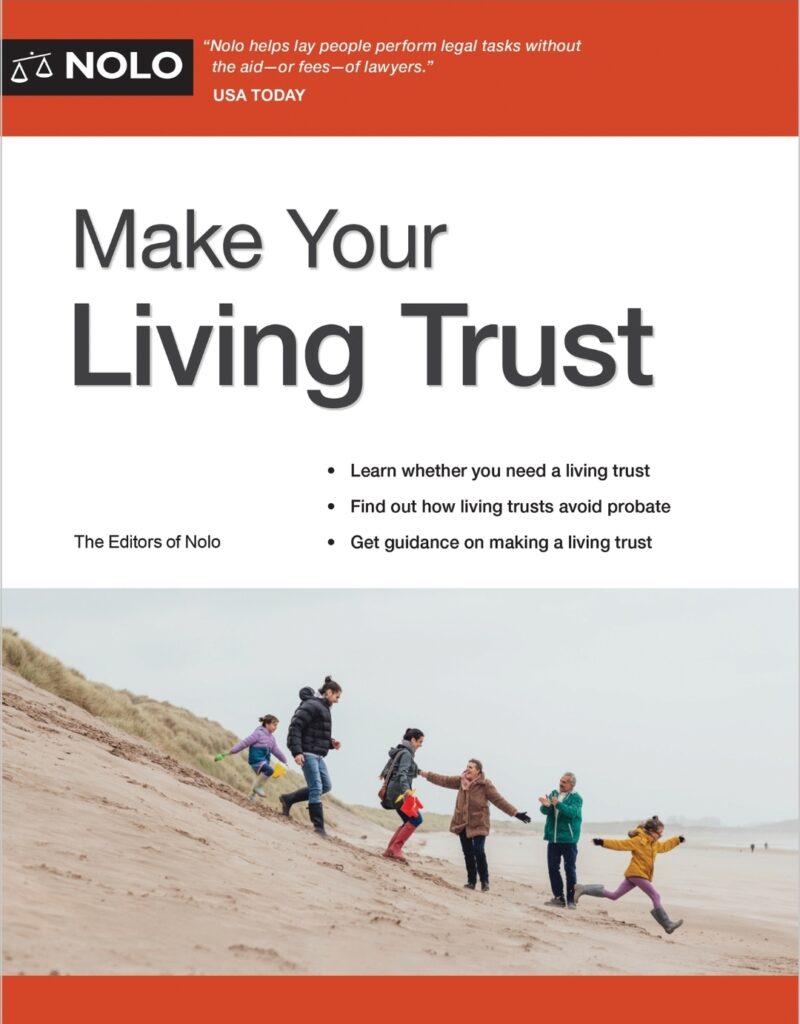
Make Your Living Trust
reading highlights & reference
Table of Contents
1. Do You Need a Living Trust?
1.1 Living Trust Basics
1.2 Benefits of Living Trusts
1.3 What Living Trusts Cannot Do
1.4 Drawbacks of a Living Trust
1.5 Alternatives to Making a Living Trust
2. What Kind of Trust Do You Need?
2.1 Shared Living Trusts
2.2 Property Management Trusts
2.3 Discretionary Trusts
2.4 Marital Trusts for Blended Families
2.5 Less Common Trusts
3. The Trustees of Your Living Trust
3.1 Original Trustees
3.2 Successor Trustees
3.3 Choosing a Successor Trustee
3.4 Paying a Successor Trustee
4. Property That Goes Into Your Living Trust
4.1 Types of Property
4.2 Co-Ownership
4.3 What Property to Transfer to Your Trust
5. The Beneficiaries of Your Living Trust
5.1 Primary Beneficiaries
5.2 Shared Gifts
5.3 Alternate Beneficiaries
5.4 Residuary Beneficiaries
5.5 Leaving Explanations and Instructions
6. Making a Living Trust
6.1 Deciding Whether to Hire a Lawyer
6.2 Drafting Your Own Living Trust
6.3 Hiring a Lawyer to Draft Your Living Trust
6.4 Executing Your Trust
7. Funding Your Living Trust
7.1 Transferring Untitled Property Into Your Trust
7.2 Transferring Titled Property Into Your Trust
8. Living With Your Living Trust
8.1 Copying and Sharing Your Trust
8.2 Registering Your Trust
8.3 Storing the Trust Document
8.4 Making Changes to Your Trust Document
8.5 Certifications of Trust
8.6 Revoking Your Trust
9. After Your Death
9.1 The Successor Trustee Takes Charge
9.2 The Successor Trustee’s Duties
9.3 Shared Trust—Duties of the Surviving Spouse
9.4 How a Living Trust Ends
10. Other Parts of Your Estate Plan
10.1 Other Probate Avoidance Devices
10.2 Backup Wills
10.3 Life Insurance
10.4 Durable Powers of Attorney for Finances
10.5 Health Care Directives
10.6 Tax Planning
10.7 Final Arrangements
10.8 Digital Assets
10.9 Letter to Loved Ones
10.10 Putting Everything Together
About
from Amazon:You can use a living trust to keep your estate out of probate and distribute property after you die. But how do you know whether a living trust is right for you, how do you get one, and what other documents do you need? Make Your Living Trust addresses these concerns and more by explaining:
– what probate is (and why to avoid it)
– how living trusts work
– why you might not need a living trust
– the pros and cons of making a living trust without a lawyer
– what kinds of property go into a living trust, and
– how to choose a successor trustee.
This book explains how to make a living trust—on your own or with help from an attorney. It also covers other aspects of your estate plan, like what to do with your digital assets and why you still need to make a will, financial power of attorney, and health care directive.
Reading highlights:
Trust with many names:
This book uses the term “living trust” to describe a basic estate planning trust that distributes property and keeps it out of probate. You might also hear this type of trust called a “revocable living trust” or an “inter vivos trust.” In the world of estate planning, each of these terms describes the same type of trust—one that takes effect while you’re alive and that you can change or revoke at any time. 1. Living Trust Basics/ p. 2
Key Stages of a Living Trust’s Lifecycle:
1. You create the trust. To make your living trust, you will:
- Create a trust document.
- Sign it and have it notarized.
- Transfer property into the trust.
2. You control the trust. During your life, you can:
- Change the terms of the trust.
- Add or remove trust property.
- Revoke the trust.
If you become unable to manage your affairs, the person you named as successor trustee will manage trust property until you are well.
3. Your successor trustee takes over. After you die, your successor trustee will:
- Communicate with your beneficiaries.
- Distribute trust property according to the terms of the trust.
- Pay taxes, debts, and other obligations (if there is no executor to do it).
- Manage any ongoing issues related to trust property. 1. Living Trust Basics/ p. 3
Creating a Living Trust:
1. Make the trust document.
2. Make it legal.
3. Transfer property into the trust 1.1.1 Creating a Living Trust/ p. 4
CAUTION: You must transfer your assets to the trust---this is not optional. We are going to say this several times throughout this book because forgetting to transfer property to the trust (or doing so incorrectly) is a common mistake and a disaster. Assests that remain outside the trust will, in most cases, be distributed through probate---the very process you intended to avoid.1.1.1 Creating a Living Trust/ p. 6
While alive you retain control:
You might occasionally need to prove to a third party that the trust exists. For example, a bank will want to see proof of the trust before it changes an account in your name into your name as trustee. To assure the bank that the trust exists and that you are the trustee, without handing over the entire trust document (which you might want to keep private), you can use a “Certification of Trust” that summarizes the key points of the trust, like the name of the trust, the names of the trustees, and the date on which the trust was signed.1.1.2 While Alive You Retain Control/ p. 7
After You Die, the Successor Trustee Takes Over:
After you die, the person you named in your trust document to be the successor trustee takes over. This person transfers trust property to the relatives, friends, entities, or charities you named as the trust beneficiaries. No probate is necessary for property held in trust. In many cases, the successor trustee can handle the whole thing within a few weeks. Sometimes, however, trusts have more long-term needs. For example, say your trust leaves money to a child to use for educational purposes until they turn 25, at which point they can have it outright. The successor trustee will manage that property and decide how to spend it until the child turns 25. Depending on the child’s age, this could be years or decades. After the successor trustee has transferred all trust property to the beneficiaries, the living trust ceases to exist. In the overwhelming number of cases, the trustee will never have to go to court or file any documents, even when the job is done. 1.1.3 After You Die, the Successor Trustee Takes Over/ p. 8
Benefits of Living Trusts:
1. Determining Who Gets Your Property
2. Avoiding Propbate
3. Avoiding the Need for a Conservatorship or Guardianship
4. Keeping Your Estate Plan Confidential
5. Planning for Long-Term Property Management 1.2 Benefits of Living Trusts/ p. 9
About Probate:
After someone dies, an inventory of their estate (everything they own and owe) must be taken; bills, taxes, and other obligations must be paid; and any remaining property must be distributed to the people who legally deserve it. The deceased person’s family (or more commonly, the lawyer they hire) does the actual inventory and distribution, but the probate court oversees the process through rigid and sometimes convoluted systems. Court bureaucracy and calendar backups usually cause probate to take a long time—at least six months, often a year or more. During that time, the court puts a freeze on financial accounts, the family can’t sell or transfer real estate, and beneficiaries cannot receive any property from the estate. Although it might strain credulity at times, the purpose of probate is not to delay and frustrate—it’s to make sure that the deceased person’s wishes are, in fact, being followed. During that time, the estate will also rack up court and lawyer fees. The size of these costs usually depends on the location and the complexity of the estate. But you can count on them being more than you want them to be—often a significant percent of the value of the estate, even for relatively simple situations. In fact, some states have statutory schemes for calculating attorneys’ fees based on the gross value of the estate, regardless of the estate’s complexity. These calculations can result in outrageous fees for what is essentially (in simple estates) just paperwork.1.2.2 Avoiding Probate/ p. 10
How Living Trusts Avoid Probate:
When you make a living trust and name a successor trustee, you’re accepting that instead of having the probate court oversee the distribution of your estate, your successor trustee will do it. If all goes well, the successor trustee does not have to file anything with the court and can distribute trust property as you’ve instructed in the trust document.
It will be a lot of work for your trustee, who might still need help from lawyers or financial professionals. However, compared to sending your estate through probate, you can count on your living trust to provide significant savings of time and money for your beneficiaries and the people responsible for wrapping up your estate.1.2.2 Avoiding Probate/ p. 11
Avoiding the Need for a Conservatorship or Guardianship:
If you haven’t made a living trust or other arrangements (like a durable power of attorney) for someone to take over your finances if you become incapacitated, a court must appoint someone to do it. Typically, the spouse or adult child of the incapacitated person seeks this authority and is called a conservator or guardian.
It’s generally a good idea to avoid conservatorships because the court process of assigning a conservator can be time-consuming, expensive, and even embarrassing. Your loved ones would have to ask the court to rule that you cannot take care of your own affairs—a public airing of a very private matter. And there’s also no guarantee that the judge would appoint the person you would have chosen to do the job.
Using a living trust can avoid conservatorships because your successor trustee will already be appointed to manage trust property. 1.2.3 Avoiding the Need for a Conservatorship or Guardianship/ p. 12
Keeping Your Estate Plan Confidential:
If you have a will, your executor must file it with the probate court when you die, and the will becomes a matter of public record. In contrast, in most states, a living trust isn’t filed with the court, and (unless someone legally challenges the trust or the trustee) the trust never becomes part of any public record.
A few states require living trusts to be “registered” with the local county probate court, and many others allow it. Registration acknowledges the trust’s existence and gives the court jurisdiction over any disputes involving it. However, neither you nor the estate will face penalties for not registering, and the court will still have jurisdiction if a dispute is filed. So, registration is not a privacy concern to worry about. 1.2.4 Keeping Your Estate Plan Confidential/ p. 13
Planning for Long-Term Property Management
Another advantage of using a living trust to avoid probate (specifically compared to wills) is that living trusts can be useful for estate plans that take a long time to resolve. For example, if you want to give your child their inheritance a little at a time over many years, you could set your living trust up to handle this. Your successor trustee could manage that property for as long as necessary without any court intervention.1.2.5 Planning for Long-Term Property Management/ p. 13
What living trusts cannot do:
1. Shelter assets for Medicaid Eligibility
2. Convey Your Wishes About Medical Intervention
3. Protect assets from creditors.
4. Protect assets from Gift and Estate Tax Liability
5. Change your obligations to your family
6. Nominate a personal guardian for your minor child1.3 What Living Trusts Cannot Do/ p. 13
Shelter Assets for Purposes of Medicaid Eligibility
Assets held in a living trust are “countable resources” for purposes of Medicaid qualification. Because you have complete control over trust assets, the government considers them the same as if you owned them in your own name.1.3.1 Shelter Assets for Purposes of Medicaid Eligibility/ p. 14
Convey Your Wishes About Medical Intervention
You’ll need health care directives—like a living will and a medical durable power of attorney—to make your wishes clear and legally binding.1.3.2 Convey Your Wishes About Medical Intervention/ p. 15
Protect Assets From Creditors
Because you keep the power to transfer the property back to yourself or revoke the trust entirely, if a creditor sues you and wins, and a court issues a judgment against you, the creditor can seize trust property to pay off the judgment.1.3.3 Protect Assets From Creditors/ p. 15
Protect Assets From Gift and Estate Tax Liability
A basic revocable living trust cannot reduce federal gift and estate taxes. The IRS calculates the amount of tax your estate will owe after your death using the value of the taxable gifts you made during your life combined with the value of your estate at your death. Gifts you make through your living trust do not affect this calculation. However, keep in mind that most people do not need to worry about federal estate and gift taxes. In 2025, only estates valued over $13.99 million (including taxable gifts made during your life) will be liable for estate taxes. The estates of married couples are even less likely to owe gift and estate tax because together they can leave a combined estate of up to $27.98 million in assets without owing federal gift or estate tax. If your estate is large enough to be concerned about estate taxes (or if you’re concerned because you live in one of the handful of states with a lower threshold for state estate taxes), other types of trusts can help reduce your estate tax liability. For example, if you and your partner are unmarried and your combined estates are close to the nearly $14 million threshold for individuals, you can use an “AB trust” to keep the last-living partner from owing estate tax on the combined amount. 1.3.4 Protect Assets From Gift and Estate Tax Liability/ p. 15
Change Your Obligations to Your Family
Most married people leave much, if not all, of their property to their spouses. But if you don’t leave your spouse at least half of your property, your spouse might have the right to go to court and claim some of your property after your death. Some or all of the property you had earmarked for other beneficiaries would go to your spouse. Some states also protect a spouse’s right to the marital home.1.3.5 Change Your Obligations to Your Family/ p. 16
Nominate a Personal Guardian for Your Minor Child
You cannot use your living trust to nominate a personal guardian for your minor child. You must accomplish this task in a will. For this reason (and a few others), using a backup will in conjunction with your living trust is a very good idea.1.3.6 Nominate a Personal Guardian for Your Minor Child/ p. 16
Drawbacks of a Living Trust
1. Paperwork
2. Record Keeping
3. Transfer Taxes
4. Difficulty Refinancing Trust Property
5. No Cutoff of Creditors' Claims1.4 Drawbacks of a Living Trust/ p. 16
Paperwork
The first step is to create and print out a trust document, which you should sign in front of a notary public. That part is no harder than making a will.
There is, however, one more essential step to making a living trust effective: You must transfer the ownership of all the property you listed in the trust document to yourself as trustee of the trust.
If an item of property doesn’t have a title (ownership) document, you can simply list it on an assignment of property and attach it to your trust. Most books, furniture, electronics, jewelry, appliances, musical instruments, and many other kinds of property can be handled this way.
But if an item has a title document—real estate, stocks, mutual funds, bonds, money market accounts, or vehicles, for example—you must change the title document to show that the property is held in trust. For example, if you want to put your house into your living trust, you must prepare and sign a new deed, transferring ownership to you as trustee of the trust.1.4.1 Paperwork/ p. 16
Record Keeping
After you create a revocable living trust, little day-to-day record keeping is required. No separate income tax records or returns are necessary as long as you are both the grantor and the trustee. (IRS Reg. § 1.671-4.) You report income from property held in the living trust on your personal income tax return. You must keep written records whenever you transfer property to or from the trust, which isn’t difficult unless you transfer a lot of property in and out of the trust. 1.4.2 Record Keeping/ p. 17
Transfer Taxes
Transfers of real estate to revocable living trusts are almost always exempt from transfer taxes that state and local governments usually impose on real estate transfers. But in a few states, transferring real estate to your living trust could trigger a tax. 1.4.3 Transfer Taxes/ p. 17
Difficulty Refinancing Trust Property
Because legal title to trust real estate is held in the name of the trustee, sometimes banks and title companies balk if you want to refinance it. However, showing them proof that your trust document gives you, as trustee, the power to borrow against trust property should reassure them. In the unlikely event that you can’t convince an uncooperative lender to deal with you in your capacity as trustee, you’ll have to find another lender or transfer the property out of the trust and back into your name. Later, after you refinance, you can transfer it back into the living trust.1.4.4 Difficulty Refinancing Trust Property/ p. 17
No Cutoff of Creditors' Claims
If your property goes through probate, creditors have only a certain amount of time to file claims against your estate. A creditor who was properly notified of the probate court proceeding cannot file a claim after the claim period—about six months in most states—expires. When property is subject to a trust rather than probate, creditors still have the right to be paid from the trust assets (assuming the debt is valid). The law does not provide for a formal claim procedure, however. And, because the trust isn’t a public document in most cases, a creditor might not immediately know that the grantor is deceased, let alone who inherited the deceased debtor’s property. If the creditor finds out about the death and the inheritors, it can file a lawsuit against the estate or the recipient of estate funds. Some creditors decide that filing a lawsuit is not worth their time or money. 1.4.5 No Cutoff of Creditors' Claims/ p. 18
Alternatives to Making a Living Trust
1. Other Ways to Distribute Your Property
2. Other Ways to Avoid Probate
3. Other Ways to Plan for Incapacity1.5 Alternatives to Making a Living Trust/ p. 19
Other ways to distribute your property/ Wills
Wills
A will’s primary purpose is to distribute your property after you die, and a will that names a beneficiary will accomplish the same result as naming that beneficiary in a trust. However, beyond distributing your property, there are important differences between the two, and understanding these differences might help you decide which document you want to use to distribute your property.
With both wills and trusts, you can:
- Name beneficiaries for property that you currently own.
- Provide property management for gifts you leave to young beneficiaries.
- Make a plan for paying debts and taxes.
- Name someone (an executor or a trustee) to manage your estate.
With wills but not trusts, you can:
- Name beneficiaries for property that you don’t yet have.
- Name guardians to care for your minor children and their property.
- Forgive debts people owe to you.
With living trusts but not wills, you can:
- Keep property out of probate.
- Create complex or long-term plans for property management.
- Make a plan for incapacity.1.5.1.1 Wills/ p. 20
Other ways to distribute your property/ Intestate Succession
Intestate Succession
Intestacy is what happens when you die without a plan for your property—you die “intestate.” Without a plan (a will, a living trust, beneficiary designations, or another estate planning tool), state law will determine who gets your property. The scheme the court follows to distribute your property is called “intestate succession.” Each state has its own rules, but in all states, who gets your property under intestate succession depends on who your closest relatives are.
the probate court cannot find any relative, your property will go to the state government (or get tossed, depending on its value), but this rarely happens. If you’re okay with how the state will distribute your property and you don’t want any other benefit of making a will or trust, then you can reasonably rely on intestate succession to distribute your property instead of using a will or trust.1.5.1.2 Intestate Succession/ p. 21
Other ways to avoid probate
If avoiding probate is the primary reason you want to make a living trust, consider whether you can use the tools described below instead. Many have little cost and are simpler and easier to revise than a living trust.
1.5.2 Other Ways to Avoid Probate/ p. 23
Other ways to avoid probate/ Pay on Death Bank Accounts
Pay on Death Bank Accounts
Pay on death (POD) bank accounts offer one of the easiest ways to keep money—even large sums—out of probate. All you need to do is fill out a simple form provided by your bank, naming the person you want to inherit the money in the account at your death. As long as you are alive, the person you named to inherit the money in a POD account has no rights to it. You can spend the money, name a different beneficiary, or close the account. At your death, the beneficiary goes to the bank, shows identification and proof of death, and collects whatever funds are in the account. The probate court is never involved. 1.5.2.1 Pay on Death Bank Accounts/ p. 23
Other ways to avoid probate/ Transfer on Death Registration of Securities
Transfer on Death Registration of Securities
You can almost always name beneficiaries to inherit your stocks, bonds, or brokerage accounts without probate. It works very much like a POD bank account. When you register your ownership, either with the stockbroker or the company itself, you request to take ownership in “beneficiary form.” When the papers that show your ownership are issued, they will also show the name of your beneficiary. After registering ownership this way, the beneficiary has no rights to the stock as long as you are alive. You can sell it, give it away, or name a different beneficiary. However, upon your death, the beneficiary can claim the securities without probate simply by providing proof of death and some identification to the broker or transfer agent.1.5.2.2 Transfer on Death Registration of Securities/ p. 23
Other ways to avoid probate/ Transfer on Death Deeds for Real Estate
Transfer on Death Deeds for Real Estate
[outside of MD] ... you can prepare a deed now but have it take effect only at your death. Like a regular deed, you must have it notarized and recorded (filed in the county land records office). But unlike a regular deed, you can revoke it at any time. The deed must expressly state that it does not take effect until your death. While not all states currently allow transfer on death deeds, each year additional states begin to offer them.1.5.2.3 Transfer on Death Deeds for Real Estate/ p. 24
Other ways to avoid probate/ Transfer on Death Registration for Vehicles
Transfer on Death Registration for Vehicles
Arizona, Arkansas, California, Colorado, Connecticut, Delaware, Illinois, Indiana, Kansas, Maryland, Minnesota, Mississippi, Missouri, Montana, Nebraska, Nevada, New Jersey, Ohio, Oklahoma, Texas, Vermont, and Virginia offer vehicle owners the sensible option of naming a beneficiary, right on the certificate of title or title application, to inherit a vehicle. If you do this, the beneficiary you name has no rights as long as you are alive. You are free to sell or give away a car or name someone else as the beneficiary. To name a transfer on death beneficiary, in most states you apply for registration in “beneficiary form.” The new certificate lists the name of the beneficiary who will automatically own the vehicle after your death. You can find more information on the website of your state’s motor vehicles department.1.5.2.4 Transfer on Death Registration for Vehicles/ p. 24
Other ways to avoid probate/ Retirement Plans
Retirement Plans
Retirement plans, such as IRAs, 401(k)s, and Keoghs, don’t have to go through probate. All you need to do is name a beneficiary to receive the funds at your death, and no probate will be necessary.1.5.2.6 Retirement Plans/ p. 24
Other ways to avoid probate/ Life Insurance
Life Insurance
Life insurance proceeds are subject to probate only if the beneficiary named in the policy is your estate. That’s done occasionally if the estate will need immediate cash to pay debts and taxes, but it’s usually counterproductive because doing so could greatly increase probate fees. To keep the proceeds of your life insurance policy out of probate, do not name your estate as the beneficiary. Instead, name a person, group of people, or entity. You can even name your living trust as the beneficiary of your life insurance policy if you want the proceeds to be distributed according to the terms of your trust.1.5.2.5 Life Insurance/ p. 25
Other ways to avoid probate/ Joint Tenancy
Joint Tenancy
Joint tenancy is an efficient and practical way to transfer some kinds of property without probate.
Joint tenancy is a way two or more people can hold title to property they own together. In most states, joint owners (called joint tenants) must own equal shares of the property. When one joint owner dies, the surviving owners automatically get complete ownership of the property. This is called the “right of survivorship.” The property doesn’t go through probate court—there is only some simple paperwork to fill out to transfer the property into the name of the surviving owner.
A will or living trust doesn’t affect who inherits joint tenancy property. So, even if your will or living trust leaves your half-interest in joint tenancy property to someone else, the surviving owners will still inherit it.
This rule isn’t as ironclad as it might sound. You can, while still alive, break the joint tenancy by transferring your interest in the property to someone else (or, in some states, to yourself, but not as a joint tenant).
Joint tenancy often works well when couples acquire real estate or other valuable property together. If they take title in joint tenancy, probate is avoided when the first owner dies—though not (unlike a living trust) when the second owner dies.
All of that said, joint tenancy is not always a good choice...1.5.2.7 Joint Tenancy/ p. 26
Tenancy by the Entirety
Community Property With Right of Survivorship
Community Property Agreements
Simplified Probate Proceedings
Other Ways to Plan for Incapacity
If you’re thinking about making a living trust primarily to ensure that someone will have the authority to take care of your property and assets if you become unable to manage your own affairs, you might consider whether a durable power of attorney is a better tool for the job. The biggest downside to using a living trust as a plan for incapacity is that your successor trustee will have authority only over the property you’ve transferred into your trust. Many types of property do not belong in your living trust (see Chapter 4), so it would be very unusual for a living trust alone to be a sufficient plan for incapacity.
You must make a durable power of attorney for finances to give someone authority over property not included in your living trust. A power of attorney can give another person (your agent) total or very precise power to act on your behalf if you’re unable to manage your affairs. Making a durable power of attorney is the most important thing you can do to prepare for incapacity, and nearly every adult should have one. However, in some situations, you might want both a living trust and a durable power of attorney in your plan for incapacity—for example, if you have multiple properties and do not want the same person to manage each one.
2. What Kind of Trust Do You Need?
2.1 Shared Living Trusts
2.1.1 Shared Living Trusts Aren’t for Everyone
2.1.2 How a Shared Living Trust Works
2.2 Property Management Trusts
2.2.1 Trusts That Benefit Children and Young Adults
2.2.2 Trusts That Protect Assets for Unreliable Beneficiaries
2.2.3 Trusts That Provide for Beneficiaries With Disabilities
2.3 Discretionary Trusts
2.4 Marital Trusts for Blended Families
2.5 Less Common Trusts
3. The Trustees of Your Living Trust
3.1 Original Trustees
3.2 Successor Trustees
3.2.1 Duties in Case of Your Incapacity
Duties After Your Death
3.3 Choosing a Successor Trustee
3.3.1 Naming More Than One Trustee
3.3.3 Naming Alternatives
3.3.4 Naming a Professional Fiduciary
3.3.5 Naming An Institution as Successor Trustee
3.3.6 Avoiding Conflicts With Your Will and Other Documents
3.4 Paying a Successor Trustee
4. Property That goes Into Your Living Trust
4.1 Types of Property
4.1.1 Real Estate
4.1.2 Small Business Interests
4.1.3 Bank Accounts
4.1.4 Vehicles
4.1.5 Life Insurance
4.1.6 Securities
4.1.7 Cash
4.1.8 Retirement Accounts
4.1.9 Intellectual Property
4.1.10 Digital Assets
4.1.11 Tangible Personal Property
4.2 Co-Ownership
4.2.1 Tenancy in Common
4.2.2 Joint Tenancy
4.2.3 Tenancy by the Entirety
4.2.4 Community Property
4.3 What Property to Transfer to Your Trust
5. The Beneficiaries of Your Living Trust
5.1 Primary Beneficiaries
5.1.1 Your Spouse
5.1.2 Your Successor Trustee
5.1.3 Your Children
5.1.4 Otehr Minors or Young Adults
5.1.5 Charities and Other Organizations
5.2 Shared Gifts
5.3 Alternate Beneficiaries
5.3.1 Second Alternates
5.3.2 Alternates for Shared Gifts</span<
5.3.3 Survivorship
5.4 Residuary Beneficiaries
5.5 Leaving Explanations and Intsructions
6. Making a Living Trust
6.1 Deciding Whether to Hire a Lawyer
6.1.1 The Complexity of Your Property
6.1.2 The Complexity of Your Wishes
6.1.3 The Complexiy of Your Personal Circumstances
6.1.4 Your Ability to Pay for an Attorney
6.1.5 How Quickly You Need It
6.1.6 Your Preference for Doing It Yourself
6.1.7 Best of Both Worlds?
6.2 Drafting Your Own Living Trust
6.2.1 Choosing a DIY Product
6.2.2 Making Your Trust Document
6.3 Hiring a Lawyer to Draft Your Living Trust
6.3.1 Finding a Lawyer
6.3.2 Working With a Lawyer
6.4 Executing Your Trust
7. Funding Your Living Trust
7.1 Transfering Untitled Property Into Your Trust
7.2 Transferring Titled Property Into Your Trust
7.2.1 Real Estate
7.2.2 Bank Accounts and Safe Deposit Boxes
7.2.3 Vehicles, Boats, and Planes
7.2.4 Securities
7.2.5 Business Interests
7.2.6 Copyrights
7.2.7 Patents and Trademarks
7.2.8 Life Insurance
7.2.9 Digital Assets
8. Living With Your Living Trust
8.1 Copying and Sharing Your Trust
8.2 Registering Your Trust
8.3 Making Changes to Your Trust Document
8.3.1 When to Make Changes
8.3.2 Adding or Deleting Property
8.3.3 Trust Amendments
8.3.4 Trust Restatements
8.4 Certification of Trust
8.5 Revoking Your Trust
9. After Your Death
9.1 The Successor Trustee Takes Charge
9.1.1 More Than One Successor Trustee
9.1.2 If a Successor Trustee Resigns
9.1.3 Removing a Trustee
9.2 The Successor Trustee’s Duties
9.2.1 Getting Appraisals
9.2.2 Preparing an Affidavit of Assumption of Duties
9.2.3 Communicating With Beneficiaries
9.2.4 Transferring Property to Beneficiaries
9.2.5 Property Management
9.3 Shared Trust—Duties of the Surviving Spouse
9.3.1 The Deceased Spouse’s Trust
9.3.2 The Surviving Spouse’s Trust
9.3.3 When the Surviving Spouse Dies
9.4 How a Living Trust Ends
10. Other Parts of Your Estate Plan
10.1 Other Probate Avoidance Devices
10.2 Backup Wills
10.2.1 Why You Still Need a Will
10.2.2 Where to Get a Backup Will
10.2.3 Making a Backup Will
10.2.4 Pour-Over Wills
10.3 Life Insurance
10.4 Durable Powers of Attorney for Finances
10.4.1 Whom to Name as your Agent
10.4.2 Your Agent's Responsibilities
10.4.3 Your Agent's Powers
10.4.4 When Your Document Takes Effect
10.4.5 Making a Power of Attorney
10.5 Health Care Directives
10.6 Tax Planning
10.7 Final Arrangements
10.8 Digital Assets
10.9 Letter to Loved Ones
10.10 Putting Everything Together