
The Unexpected Legacy of Divorce
Grand Central Publishing
ISBN: 978-0786863945
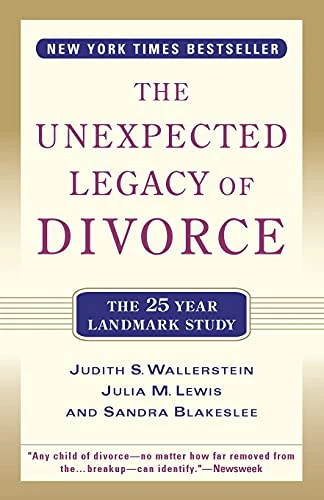
The Unexpected Legacy of Divorce
reading highlights & reference
from Amazon: Divorce is at once a widespread reality and a painful decision, so it is no surprise that this landmark study of its long-term effects should both spark debate and find a large audience.
In this thought-provoking book, Judith Wallerstein explains that, while children do learn to cope with divorce, it in fact takes its greatest toll in adulthood, when the sons and daughters of divorced parents embark on romantic relationships of their own. Wallerstein sensitively illustrates how children of divorce often feel that their relationships are doomed, seek to avoid conflict, and fear commitment. Failure in their loving relationships often seems to them preordained, even when things are going smoothly.
As Wallerstein checks in on the adults she first encountered as youngsters more than twenty-five years ago, she finds that their experiences mesh with those of the millions of other children of divorce, who will find themselves on every page.
Highlights:
In July 1999, Sesame Street aired an episode in which Kermit the Frog, dressed as a reporter, interviewed a little bird asking her where she lived. The happy little bird chirped that she lives part of the time in one tree where she frolics in her mother’s nest and the rest of her time in a separate tree where she frolics with her dad. The little bird concluded merrily, “they both love me,” and ran off to play. This, of course, restates the beguiling myth of divorce. Watching this, we are meant to understand that divorce is a minor upheaval and normal occurrence in the lives of children and adults. Not to worry, it says to the child. Your parents will continue their loving play with you as always. Your life will be exactly like it was before, only it will now take place in two locales. The story may provide bland comfort to some worried children. But I suspect most know better. The story of the little bird in no way matches their experience of growing up in a divorced family, be it in one home, two homes, or any combination of living arrangements over the years. Introduction/ p. xxi
Two faulty beliefs provide the foundation for our current attitudes toward divorce. The first holds that if the parents are happier the children will be happier, too. Even if the children are distressed by the divorce, the crisis will be transient because children are resilient and resourceful and will soon recover. Children are not considered separately from their parents; their needs and even their thoughts are subsumed under the adult agenda. This “trickle down” myth is built on the enduring fact that most adults cannot fathom the child’s world view and how children think. The problem is, they think they do. Indeed, many adults who are trapped in very unhappy marriages would be surprised to learn that their children are relatively content. They don’t care if Mom and Dad sleep in different beds as long as the family is together. Introduction/Cherished myths/ p. xxiii
Children in postdivorce families do not, on the whole, look happier, healthier, or more well adjusted even if one or both parents are happier. National studies show that children from divorced and remarried families are more aggressive toward their parents and teachers. They experience more depression, have more learning difficulties, and suffer from more problems with peers than children from intact families. Children from divorced and remarried families are two to three times more likely to be referred for psychological help at school than their peers from intact families. More of them end up in mental health clinics and hospital settings. There is earlier sexual activity, more children born out of wedlock, less marriage, and more divorce. Numerous studies show that adult children of divorce have more psychological problems than those raised in intact marriages. Introduction/Cherished myths/ p. xxiii
It has made it harder for parents to see or believe that their children suffer with fears and sadness after the breakup. And it has made it harder for parents to prepare their children properly for the forthcoming divorce and provide them with the comfort they need. The fact that many men and women get caught up in the search for new lovers or taxing new jobs after divorce—both of which make parents less available to their children—only serves to compound their desire to hold on to this myth.Introduction/Cherished myths/ p. xxiv
A second myth is based on the premise that divorce is a temporary crisis that exerts its most harmful effects on parents and children at the time of the breakup. People who believe this leap to the happy conclusion that the key to the child’s adjustment is the settlement of conflict without rancor. Thus the spotlight of our attention in terms of resources and interventions has been on the breakup. If the two parents don’t fight, at least in front of the children, and if they rationally and fairly settle the financial, legal, and parenting issues that divide them, why then the crisis will resolve itself in short order. The two lucky adults will have broken free of their troubled marriage and, along with their children, can move forward to build happier lives.Introduction/Cherished myths/ p. xxiv
But it’s misguided. Our willingness to believe this notion has prevented us from giving children and adults the understanding they need to cope with the divorce experience over the long haul. It has kept us from making long-term plans for our children and from acknowledging the fact that their needs change as they grow older. It has prevented us from listening to their serious complaints and easing their suffering. Thankfully, this second myth is also beginning to unravel because of a new voice that is just now emerging on the national scene. That voice belongs to the children of divorce now grown to adulthood. In this book, you will hear them challenge these myths firsthand. Now that they are grown up, have marriages, divorces, and children of their own, they speak with an authority we dare not ignore.Introduction/Cherished myths/ p. xxv
Indeed, as youngsters then and as adults now, all would be profoundly astonished to learn that any judge, attorney, mediator—indeed, anyone at all—had genuinely considered their best interests or wishes at the breakup or at any time since. It’s the many years living in a postdivorce or remarried family that count, according to this first generation to come of age and tell us their experience. It’s feeling sad, lonely, and angry during childhood. It’s traveling on airplanes alone when you’re seven to visit your parent. It’s having no choice about how you spend your time and feeling like a second-class citizen compared with your friends in intact families who have some say about how they spend their weekends and their vacations. It’s wondering whether you will have any financial help for college from your college-educated father, given that he has no legal obligation to pay. It’s worrying about your mom and dad for years—will her new boyfriend stick around, will his new wife welcome you into her home? It’s reaching adulthood with acute anxiety. Will you ever find a faithful woman to love you? Will you find a man you can trust? Or will your relationships fail just like your parents’ did? And most tellingly, it’s asking if you can protect your own child from having these same experiences in growing up.
Not one of the men or women from divorced families whose lives I report on in this book wanted their children to repeat their childhood experiences. Not one ever said, “I want my children to live in two nests—or even two villas.” They envied friends who grew up in intact families. Their entire life stories belie the myths we’ve embraced.Introduction/Cherished myths/ p. xxv
Divorce is a life-transforming experience. After divorce, childhood is different. Adolescence is different. Adulthood—with the decision to marry or not and have children or not—is different. Whether the final outcome is good or bad, the whole trajectory of an individual’s life is profoundly altered by the divorce experience.
We have been blinded to this fact by the sheer numbers of people affected and by the speed at which our society has been transformed. Many people today think divorce is a perfectly normal experience. It’s so common, children hardly notice it. No stigma. No big deal. After all, if half the child’s schoolmates come from divorced families, how could divorce be so traumatic? And isn’t it true, they say, that children raised in bad intact families are no better off? Everyone who grows up in America today is affected directly or indirectly by divorce, so everyone has the same worries. In other words, they argue that divorce places no special burdens on individuals (remember, it’s a normal experience). Indeed, if researchers were to compare groups of eighteen-year-olds from divorced and intact homes and then groups of twenty-two-year-olds and so forth they would probably find that most children of divorce and children from intact homes often hold similar views. It’s true that most young people are worried about similar things.
But I have found what I think are deeper truths to this superficial impression. First, each child experiences divorce single file. Just because others are suffering does not reduce their suffering. Would it lessen a widow’s sorrow to have five other widows on the same street? Would that make her feel less pain? Numbers provide no consolation for children or adults in many of life’s traumas. People who believe that numbers mute the individual child’s suffering have simply not talked to the children. Each child in a classroom half full of children of divorce cries out, “Why me?” Moreover, by following the life of one child of divorce, and then another and another, from early childhood through adolescence and into the challenges of adulthood, I can say without a doubt that they have worries apart from their peers raised in intact homes. These worries are reshaping our society in ways we never dreamt about. That is the subject of this book and a challenge to all of us in coming years.Introduction/What I have learned/ p. xxvii